02 · Prepared for the Meta hiring team
Factiva AI: Smart Content
Factiva's users are accountable for every claim they act on. As Senior UX Architect / Product Designer II, I led design and research for Smart Content, the generative AI layer built into search, reading and briefing: Smart Summary, the AI Assistant, Smart Reports and Smart Alerts, every claim cited and grounded in licensed content. It reframed Factiva search from finding documents to getting the answer, with the documents attached.
Why this piece is in my application
An AI layer inside a content product: generative UI, multi-step research, and a trust model where every answer stays one tap from its source.
Shipped
Generative AI live inside New Factiva for every account
Cited
Every answer traceable to a licensed source
Platform
One AI layer shared across Dow Jones products
Factiva's users are accountable for every claim they act on. I led design and research for Smart Content, Factiva's generative AI layer, so professionals could get answers in seconds and still defend every one of them.
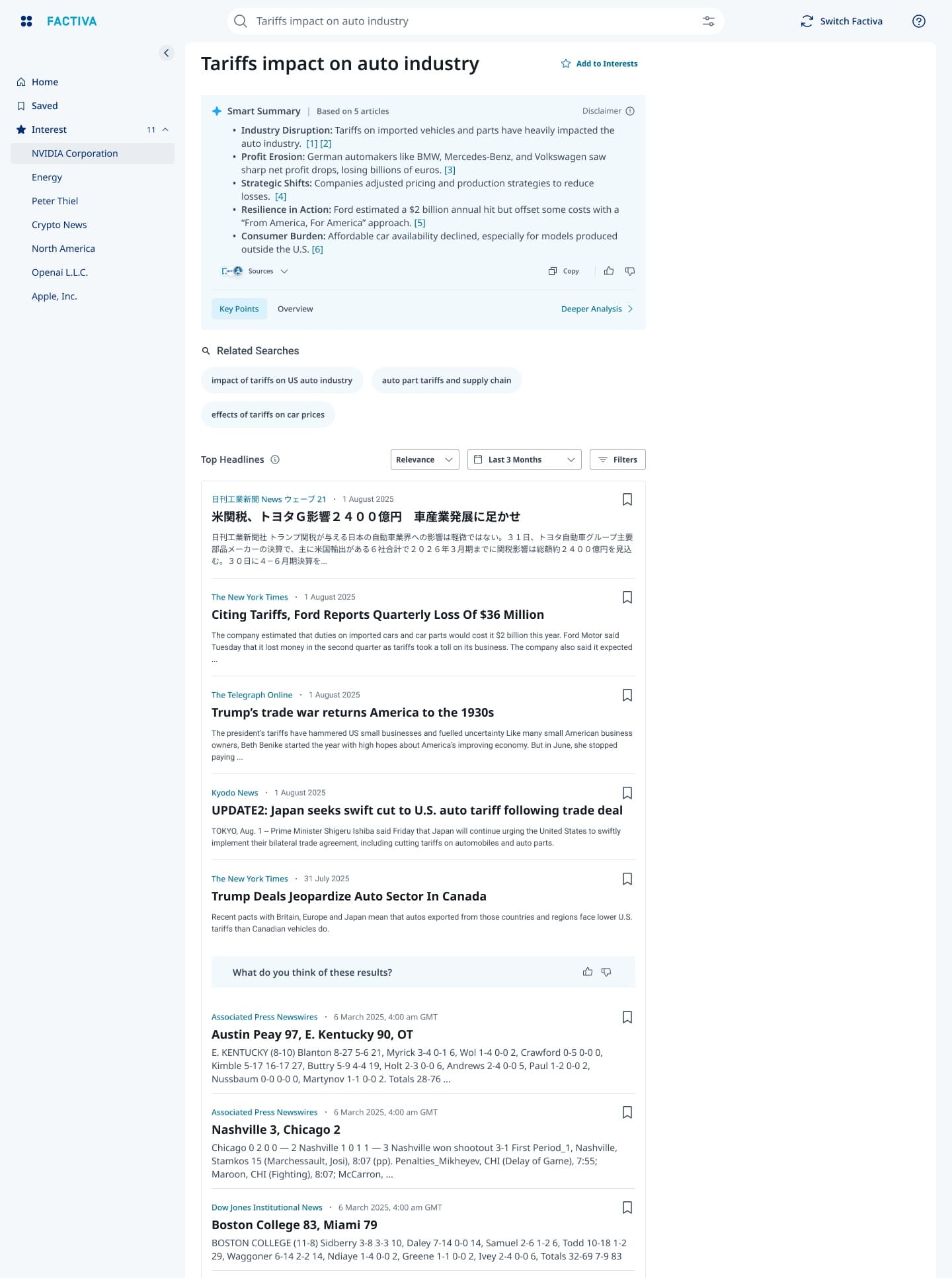
- 1AI. Scope disclosure: the summary says how many articles it was built from before giving the answer.
- 2Research. Every point carries inline citations that jump straight to the underlying article.
- 3Components. The disclaimer is a named, reusable component, so honesty about limits cannot be lost in a later revision.
- 4IA. Depth on demand: glance at Key Points or the Overview first.
- 5AI. Deeper Analysis opens a dedicated view with headline sources in a right rail.
- 6Prototype. Copy, thumbs up and thumbs down: a feedback loop on every generated output.
- 7Wireframe. The answer sits above the results, not instead of them: the documents stay attached.
The stakes
Factiva is Dow Jones's professional research platform: a vast licensed archive of news, company data and market intelligence, used by analysts, bankers, PR professionals, consultants and executives. Its depth is its value and also its cost: finding, reading and synthesizing the right material is slow, manual work. Dow Jones was the archive; the customer did all the analysis.
Generic AI does not solve that for these users. A fluent summary is no use to a banker or analyst who cannot show where each point came from, or defend it under legal and editorial scrutiny. The product had to be fast and checkable at the same time.
What I owned
- Role: Senior UX Architect / Product Designer II on Design and Research, owning design direction end to end across the milestone roadmap.
- I owned: framing the problems, mapping the research workflow from query to insight, defining the interaction model, and designing the summary, company report and chat experiences and their verification model through to build-ready specifications and handoff.
- I built the prototypes on live retrieval, so design decisions were made against real answers from the corpus rather than mock-ups.
Outcome and what I learned
- Launched inside New Factiva as a major AI release.
- The citation and trust patterns became the reference for AI experiences across Dow Jones.
- Smart Content grew from a hackathon idea into a milestone-driven, shipping initiative with sustained leadership backing.
- It reframed Factiva search from finding documents to getting the answer, with the documents attached.
- The citation and verification patterns became the trust model for AI work across Dow Jones, built as components of the Factiva, DJ+ and Index design systems rather than a separately styled AI zone.
- Engagement and trust signals were agreed with product and analytics up front, including citation clicks, which show whether people are actually checking the system.
The full case study: Platform scope · The insight: trust is the product problem · The analyst's day, before and after · Strategy: one standard of evidence · Four capabilities, one standard of evidence · Smart Summary and the citation model · The agency ladder, M1 to M4 · Trust as interface behavior · The edge states that earn trust · Results in detail · Scope as an agreement with the user · When the model shapes the layout · Designing around model behavior · The full summary · Across every breakpoint.
Platform scope
The team was a core group with the Director of Product Design, the VP of Product Platforms, the product lead and engineering. The work began as a hackathon with broad leadership sponsorship, then narrowed to a focused team for milestone delivery.
The corpus behind every answer is about two billion articles from thousands of licensed sources. And it was a platform problem, not a single feature: each AI capability is built once and used by every brand on the Dow Jones Platform, including Factiva, Oxford Analytica, Dragonfly and Dow Jones Risk Journal, so every decision about grounding, citation and format had to hold for different readers with different stakes.
The people it serves: analysts, researchers and compliance teams across those products.
The insight: trust is the product problem
Discovery, grounded in customer interviews and persona analysis, surfaced six recurring research problems across five professional personas, from analysts and consultants who live in the detail to executives who depend on their teams for synthesis. Four findings shaped everything after:
- Access alone does not help. Giving a general assistant the archive did not beat the assistant on its own; customers wanted finished work, not more raw material.
- Experts keep control. Advanced users trust what they can read and edit, so any translation of their intent has to stay visible.
- Evidence earns trust. Users rejected answers they could not inspect, not AI answers as such.
- Questions outlive the session. The same topics were searched again by hand, week after week.
Summarizing is the easy part; models already do it. The hard part was getting professionals to rely on the output for real decisions. That made verifiability a first-class feature of the design, not a disclaimer at the bottom of it.
Verifiable
Professionals act on the output, so every claim must be one tap from its evidence.
Became the decision
Inline citations, scope disclosure on every summary, and headline sources in a right rail.
In the workflow
AI earns its place where research already happens, not in a chatbot on the side.
Became the decision
Smart Summary above the results, with an on or off switch inside Search Builder.
Earned autonomy
Each step hands the system more of the task only after the last one proved trustworthy.
Became the decision
A ladder from single-shot summaries to bounded chat, unbounded chat, deep research and memory.
The analyst's day, before and after
I mapped the working day of the people we design for, Factiva, Oxford Analytica, Dragonfly and Risk Journal users, analysts, researchers and compliance teams, stage by stage: what they do, where it hurts, and what we would build there.
- Search. Today: writing and refining Boolean queries, with syntax that is hard to learn. We built: natural-language search with an optional translation into Boolean.
- Understand. Today: scanning results and opening articles with no orientation first. We built: Smart Summary, cited bullets above the results.
- Investigate. Today: comparing sources and asking colleagues, with the trail lost between tabs. We built: the AI Assistant, sources first, with follow-ups.
- Report. Today: hours rewriting findings into the house format. We built: Smart Report, generated from templates experts define.
- Monitor. Today: re-running the same searches every week and noticing change late. We built: Smart Alerts, a baseline, the change since, and a pause.
Strategy: one standard of evidence
The four capabilities were built in sequence, and all four were held to the same rule. Every answer cites the document it came from, and sources show up before the answer is written, so checking a claim never depends on the reader's patience.
- Build each capability once, at platform level, for every brand.
- Put the assistant inside the product, not in a separate destination.
- Ground every answer in licensed content, never the open web.
- Make trust and citation reusable patterns that work for both B2B and B2C.
- Shape outputs as structured, analytical formats rather than a generic chat reply.
Four capabilities, one standard of evidence
Each step in the sequence moves more of the synthesis into the product while keeping the evidence in view:
- Search: natural-language search, with an optional translation into Boolean for experts who want to see and edit the query.
- Understand: Smart Summary, a few cited bullets above the results, so the reader is oriented before opening anything. Shipped.
- Investigate: the AI Assistant, with sources shown before the answer and follow-up questions beside it. Shipped.
- Report: Smart Report, generated from a template an expert defined, filled from live licensed content, so the structure carries the analyst's judgment rather than the model's. Shipped.
- Monitor: Smart Alerts, a question plus a frequency that returns what changed against a baseline, and can be paused. In progress.
One rule held across all four: the reader can always see where a claim came from and step into the source.

Smart Summary and the citation model
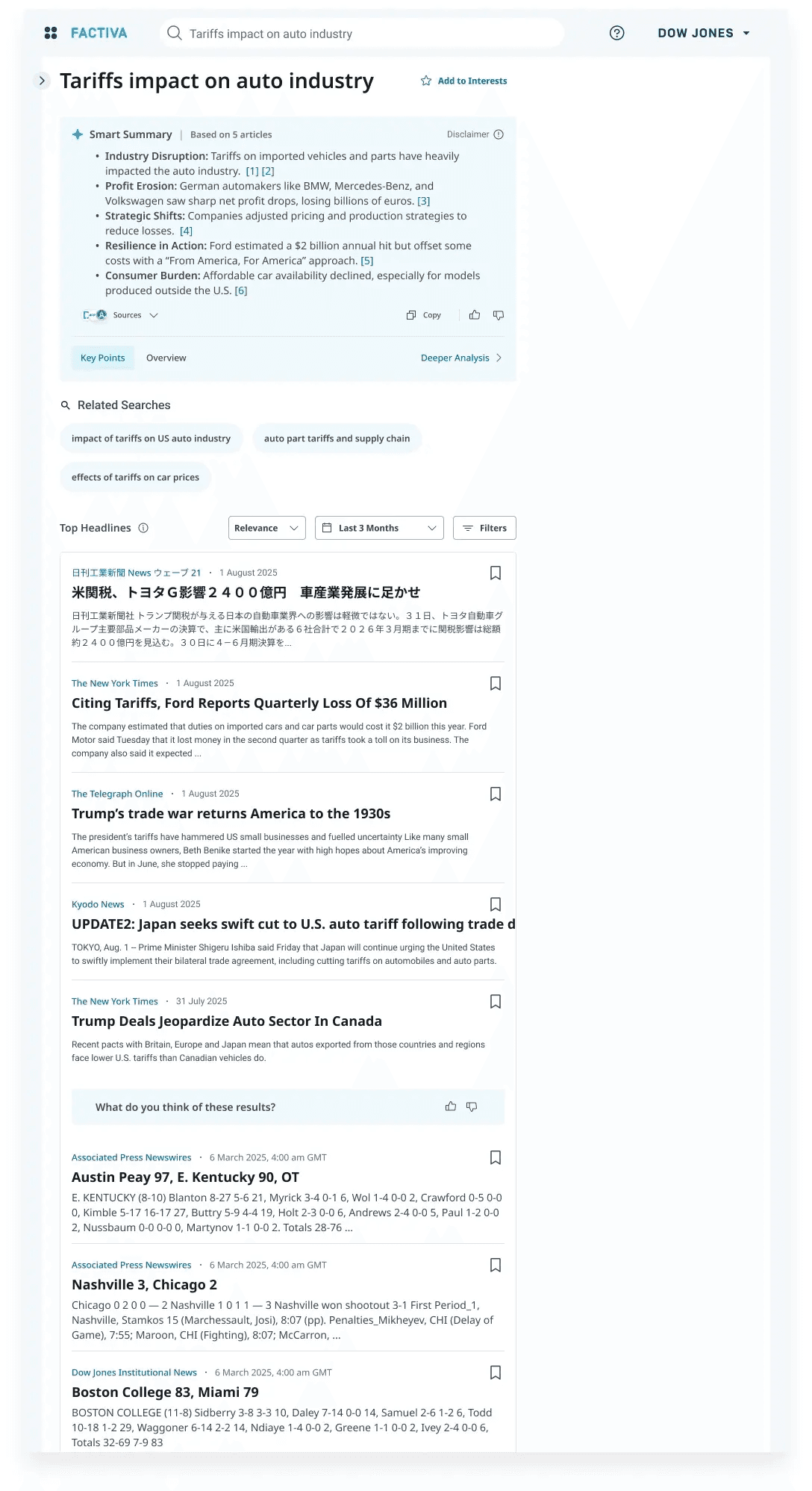
A Smart Summary gives depth on demand: a summary view, a bullets view, and a path into Deep Analysis. Readers glance first and drill down only when they need to.

Every claim carries an inline citation that opens the underlying article, and Deep Analysis keeps the headline sources in a side rail. People also stay in control of the AI itself: they can copy a summary, rate it, and choose where summaries appear, including switching them off inside Search Builder.
Tariffs impact on auto industry
Smart Summary• Higher costs on imported parts12
• Carmakers adjusting prices and production3
• Pressure on lower-cost models4
Publisher · 1h ago
Article headline one
Publisher · 2h ago
Article headline two
Publisher · 3h ago
Article headline three
The same model carried into company research. Company Summaries add lenses, tabbed views such as news, financials and strategy, each summarized and cited. Company Reports generate a long-form briefing that mixes fixed sections with sections that adapt to the company, held together by a sticky table of contents and a full references list.

The agency ladder, M1 to M4
Rather than jumping straight to a chatbot, the roadmap handed the system more of the research one step at a time. Each step had to prove itself trustworthy before the next.
- M1, single-shot synthesis: summarize what a search already returned. The citation model is earned here first.
- M2, entity reasoning: lenses and long-form company reports, the first time the system chooses some of its own structure.
- M3.0 and M3.1, conversation: chat over a defined set of content, then across the whole archive.
- M3.2, deep research: multi-step research that extracts the answer itself, not a list of documents to read.
- M3.11 and M4, memory: saved chat history, personalization, analysis across companies, and shared research.
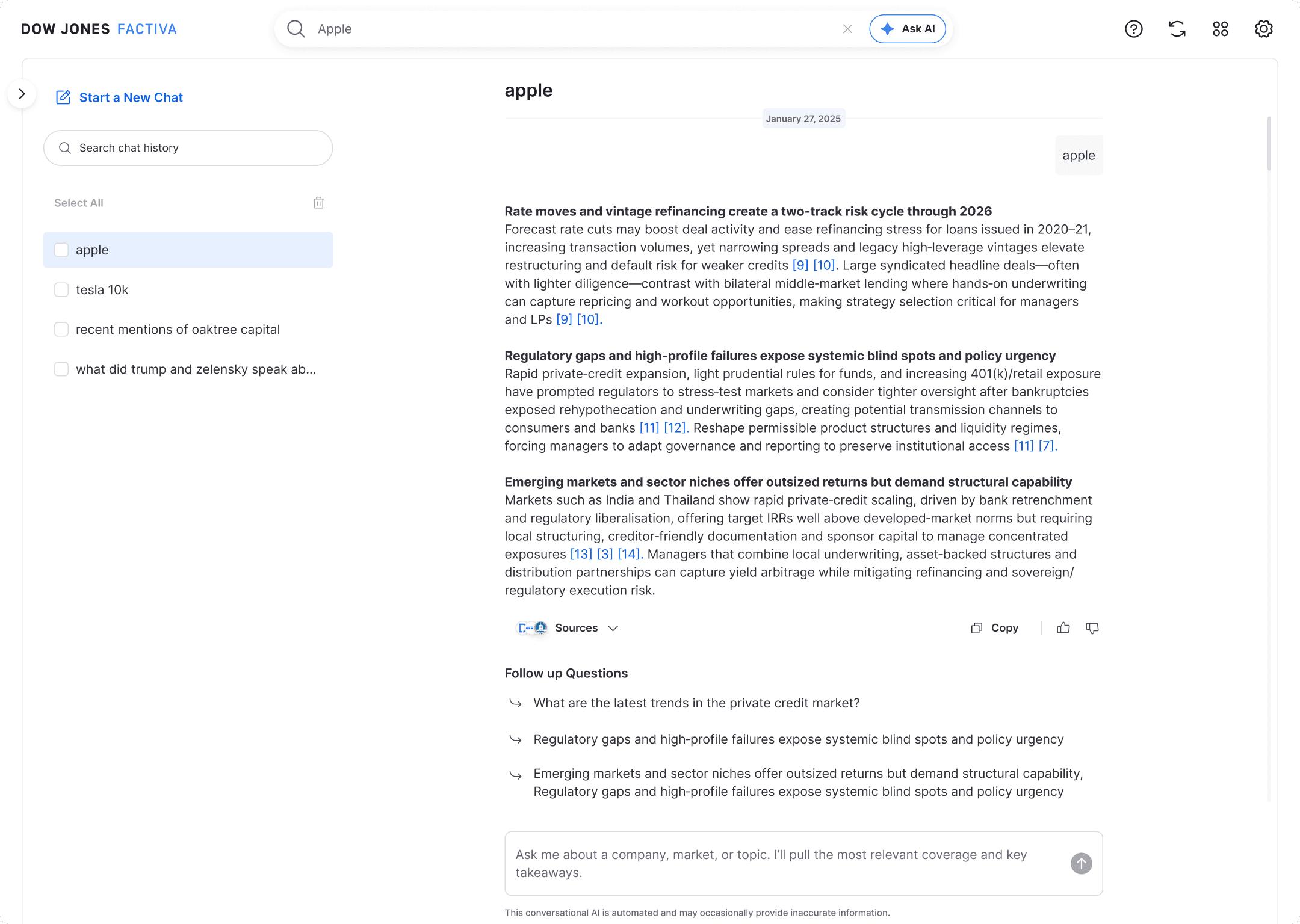
- 1AI. Ask AI lives in the search bar: a conversation starts from the same place research does.
- 2Prototype. Chat history makes AI output durable: searchable, selectable and returnable, not lost with the session.
- 3Wireframe. Answers are composed into headed sections: structured insight, not a flat paragraph.
- 4Research. Numbered inline citations tie each claim to its source.
- 5Components. Sources, copy and feedback under every answer, the same pattern as Smart Summary.
- 6IA. Follow-up questions keep the research moving instead of ending at one answer.
- 7A11y. A standing disclaimer: the assistant is automated and may occasionally be inaccurate.
The design argument in one line: autonomy is not a switch, it is a sequence of permissions the system earns.
Trust as interface behavior
The real design question sat above any single feature: not how to add chat, but what a Dow Jones AI experience should feel like for professional research, when the same capabilities serve several brands and the value of each is licensed, trusted information used in high-stakes work.
The answer was to treat trust as something the interface does, not something marketing claims. The assistant lives inside New Factiva. Every answer is grounded in licensed content and traceable to its source. And the small details carry real weight: placeholder text, return-state messages and consistent naming all tell people what kind of AI this is and what they can rely on it for.
There was a constant pull to make the assistant feel magical at the cost of clarity. For professionals, trust comes from constraints they can see and understand, so every output took a structured form: a summary is a set of cited bullets, a report follows a template an expert defined, and an alert is a question asked once and carried forward in time.
The edge states that earn trust
Much of the work went into the moments where a model falls short, not the demo where it shines.
- Scope disclosure: every briefing states its evidence base, the number of articles and the date range, before the answer.
- Freshness: reports load from cache when under 24 hours old, show a historic view when older, or regenerate. A non-blocking banner says when content may be out of date.
- Refusal: when the system cannot find what was asked, it says so and offers a new search, rather than filling the gap with plausible text.
- Dated attribution: citations name the publisher and carry a timestamp, because in financial research a source's age is part of its meaning.
- Honesty as a component: the notice that answers are automated and may be inaccurate is a named, reusable component, so it cannot be dropped in a later revision.
Results in detail
- Automatic access for every Factiva account, with no extra entitlement or setup.
- Observed among exposed users: about two-thirds start a conversation; around 2,500 users and 5,700 threads a quarter; 12% of Smart Reports are downloaded or copied; and week-one AI users return at 34% versus 23%. These are observational, not causal.
- Because the capabilities live at platform level, the same summaries, assistant and reports serve Factiva, Oxford Analytica, Dragonfly, Dow Jones Risk Journal and other brands.
- Later initiatives reused the assistant's styles and behavior, and other teams modelled shared chat layouts on it.
- The summary capability grew into company summaries and broader search and data inputs, moving Dow Jones AI from isolated feature discussions toward one platform direction.
The lesson: sequencing matters. Solving the blank-page problem first earned the right to tackle memory, cross-company analysis and collaboration. Starting again, I would bring freshness and verification patterns in even earlier, because they shaped nearly every later decision.

Scope as an agreement with the user
The central decision in an agentic research tool is how much the user lets the system do, and how clearly that boundary shows. Bounded and unbounded chat are separate modes rather than retrieval quietly widening, so users always know which territory an answer came from. Lenses work the same way: each routes one company down a different line of reasoning and returns its own cited summary, so the user directs the analysis.
When the model shapes the layout
Company Reports are partly generated: a company with a meaningful AI strategy gets an AI Strategy section that another company would not. That removes the usual design assumption that the layout is known in advance. The job becomes governing a range of possible outputs: which sections are guaranteed, which are conditional, how a section behaves when evidence is thin, and how a document of unpredictable length stays navigable. The sticky table of contents gives it a stable spine.
Designing around model behavior
- Grounding: answers come from Dow Jones licensed content, so the interface has to make where an answer came from as visible as the answer.
- Time: a model has no sense of its own currency, which is why freshness states, historic views and regeneration exist.
- Variation: when structure is generated, layouts must hold at both the sparse and the verbose end of what the system returns.
The full summary
Across every breakpoint
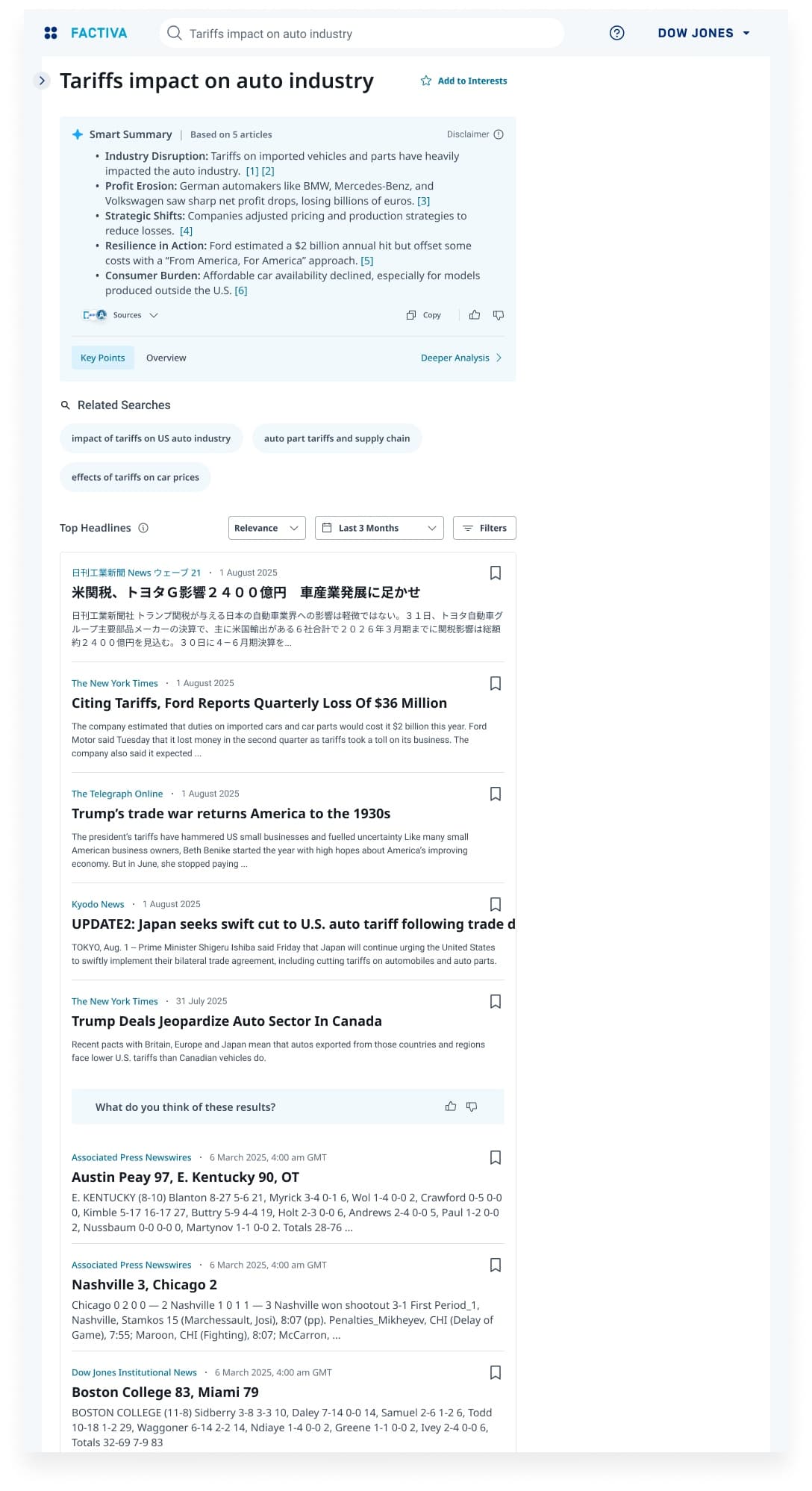
Smart Content was specified from wide desktop down to tablet and phone, so summaries stay readable and checkable on any screen.
Next case study
DSI: Design System Intelligence
Read the case study →
Interested in how I approach personalization, AI, and systems at scale? Let's talk.