Case study
Factiva Search Builder 2.0: Advanced Search for Expert Researchers
Search drives most of Factiva's usage, and its most capable search lived in a decades-old Boolean tool expert researchers refused to give up. As Senior UX Architect / Product Designer II, I redesigned advanced search around three research-backed principles, focused, in control and flexible, so power users could move to New Factiva without losing control: a readable Boolean query canvas, explicit search scope, effortless revision, unified filters, and entity links that read intent.
Most
of Factiva's usage runs through the search this work rebuilt4
connected workstreams: Search Builder, unified filters, entity-aware results, entity links3
research-backed principles: focused, in control, flexible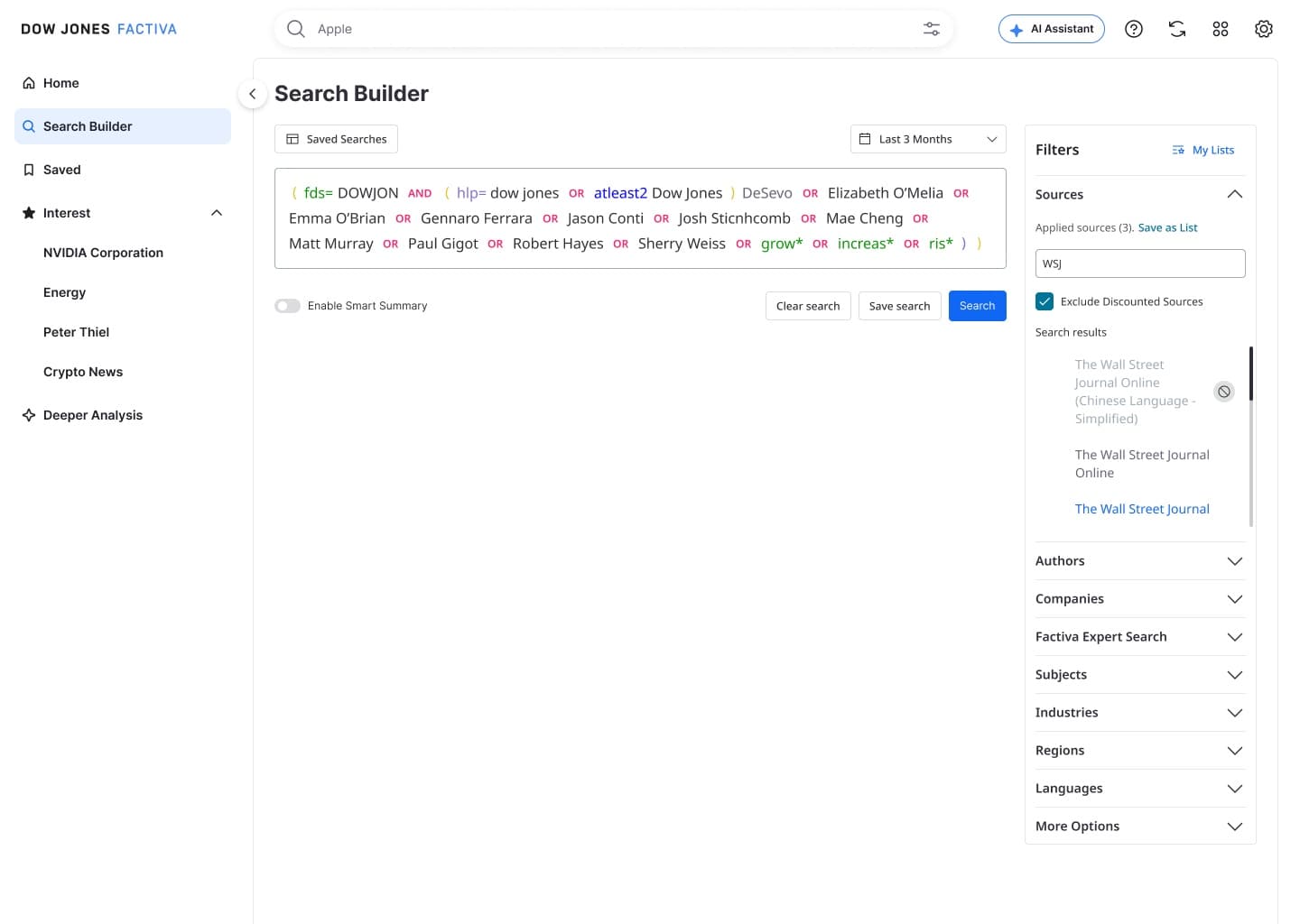
- Search & Discovery
- Enterprise UX
- Information Architecture
- Interaction Design
- UX Research
Search drives most of Factiva's usage, and its most capable search lived in Classic Factiva: a decades-old Boolean tool that expert researchers refused to give up. I redesigned advanced search so those users could move to New Factiva without losing the control they trusted.
- 1Prototype. Saved Searches up front: reuse a trusted query in one click instead of rebuilding it.
- 2Wireframe. Date range beside the query, so time scope is set before searching, not after.
- 3Tokens. Boolean kept, made readable: fields, operators and entities each get their own color.
- 4Smart Summary. AI stays opt-in: Smart Summary is a switch the researcher controls, right under the query.
- 5Research. Revise, save or clear in place. Refining never means starting over.
- 6IA. Scope always visible: the sources being searched sit next to the query.
- 7Components. One filter rail, the same in search, Explore and company pages.
What I owned
- Role: Senior UX Architect / Product Designer II, leading design and research across the search workstreams.
- I owned: framing the migration problem, turning research into design principles, and designing Search Builder, unified filters, entity-aware results and entity links through to engineering handoff.
- Partners: product management, Customer Insights research, and Factiva engineering, aligned to the Factiva and Index design systems.
The stakes
Moving customers from Classic Factiva to New Factiva was a business priority, and search was the deciding factor. If the most demanding researchers did not trust the new search, they would stay on Classic, and the platform migration would stall with them.
Outcome
- Shipped across multiple milestones with product and engineering, each workstream specified for build and aligned to the Factiva and Index design systems.
- Gave New Factiva a search credible enough for Classic Factiva's most demanding users, the precondition for the platform migration.
- Success was defined up front: Classic-to-New migration rate, adoption of Search Builder among New Factiva users, entity-link click-through, and how easily users revise a query.
Continue reading
6 sections · 4 screens are protected. Enter the password, or request access.