Case study
DPDHL IoT Platform
The Deutsche Post DHL Group IoT platform is one governed home for connected operations, where applications, devices, users, and business units are onboarded and run together rather than as a tool per use case. Its architecture rests on five core entities and a role-based access model, so the same platform serves many teams, from Warehouse Operations Intelligence to CONNECT, without fragmenting.
5
Core entities: business unit, application, device, user, associationMany
IoT applications hosted, from WOI to CONNECTRBAC
Role-based governance across the whole platform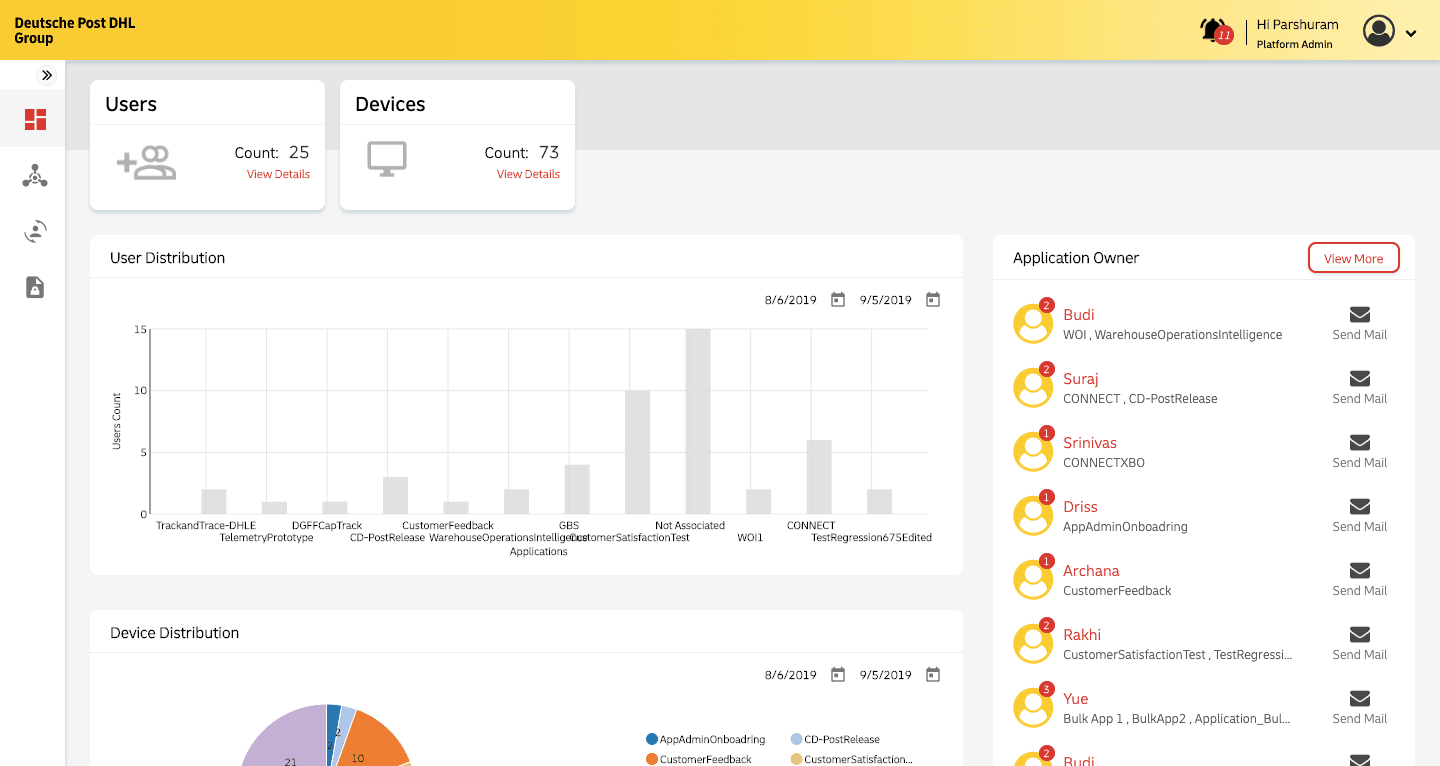
- Enterprise UX
- Platform Design
- Design Systems
- Dashboard Design
- IoT
The DPDHL IoT Platform is Deutsche Post DHL Group's home for connected operations: a single, governed place to onboard and run the IoT applications, devices, users, and business units behind DHL's use cases, from Warehouse Operations Intelligence to CONNECT. I led the UX architecture for the platform and its modules.
- 1IA. Users and devices lead as counts, so the administrator reads the scale of the platform before any chart.
- 2IA. The signed-in role, Platform Admin, sits beside the name, because role-based access governs what this view can do.
- 3Components. A slim icon rail keeps every module one click from the dashboard, so the platform reads as one home.
- 4Research. Users are plotted per application, from WOI to CONNECT, showing many apps living on one governed platform.
- 5Components. Each application lists its owner with a Send Mail action, so ownership is visible rather than buried.
The challenge
DHL was building IoT applications across the business, each with its own devices, owners, and users. Left alone, that becomes a tool per use case: separate onboarding, separate access rules, and no shared view of the connected estate.
- Every application needed devices registered and associated with it
- Every user needed the right role, responsibilities, and business unit
- Administrators needed one place to see how everything was doing
- The whole thing had to scale across DHL's layered organization
The hard part of an enterprise IoT platform is not any one screen. It is making onboarding, governance, and monitoring feel like one coherent system across every device, app, and team.
Outcome
- One governed platform replaced a tool-per-use-case sprawl
- Shared onboarding, dashboards, and a role model scaled across applications
- A consistent DHL design language unified every module
Continue reading
3 sections · 2 screens are protected. Enter the password, or request access.