Case study
Reimagining WSJ Search & Navigation
I led the redesign that turned WSJ mobile search from a content-retrieval tool into a discovery and navigation platform for millions of subscribers. A tabbed architecture unifies five content types, news, market data, opinion, video, and audio, in one search session, while seven reusable components were contributed back to the WSJ Index Design System. Nineteen screen states were fully specified, with the filter and market-data patterns reused well beyond search.
Adopted
Filter and market-data patterns reused across WSJ surfaces beyond search7
Reusable components contributed to the Index Design System5
Content types unified in one search: news, markets, opinion, video, audio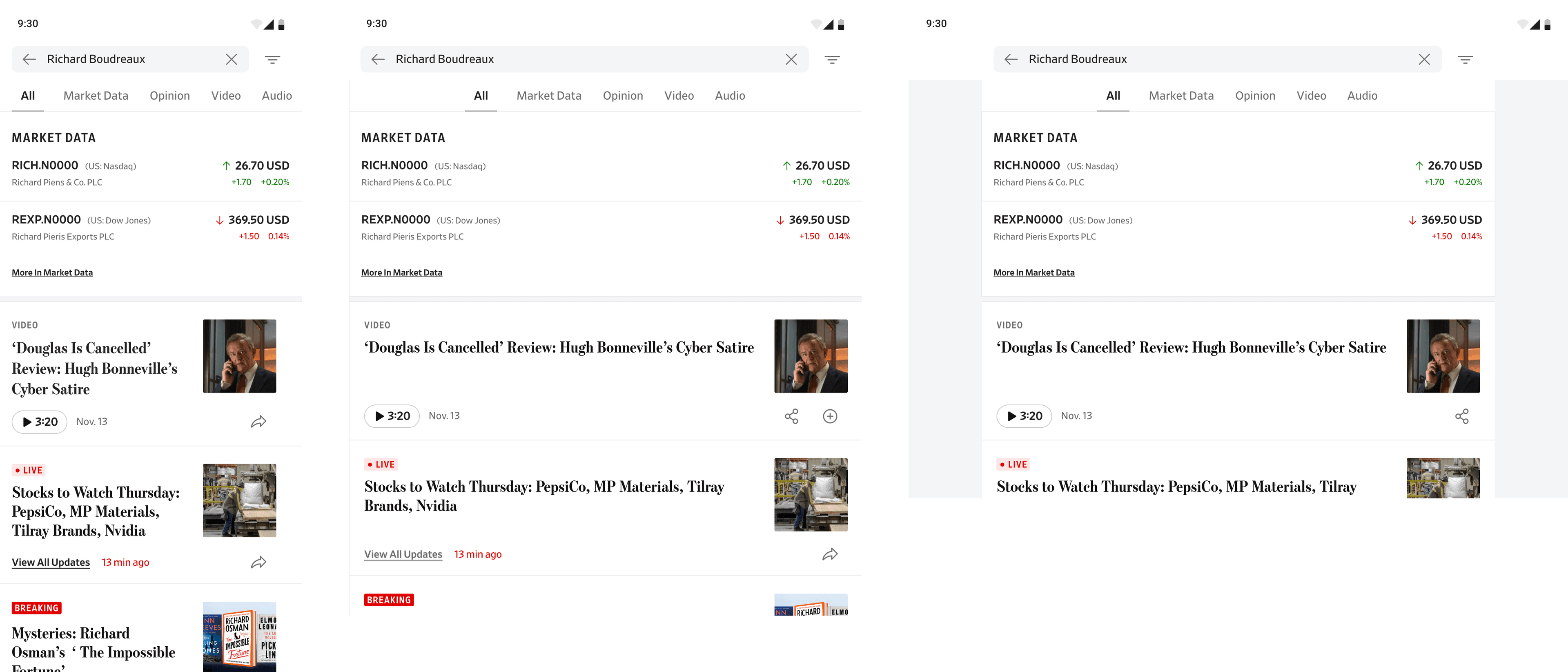
- Product Design
- Design Systems
- Mobile
- Search & Discovery
- Accessibility
Project overview
- Problem
- WSJ mobile search needed to help subscribers discover stories, market data, and other formats in one session.
- My contribution
- I led the mobile search redesign across iOS and Android and specified 19 screen states.
- Design decision
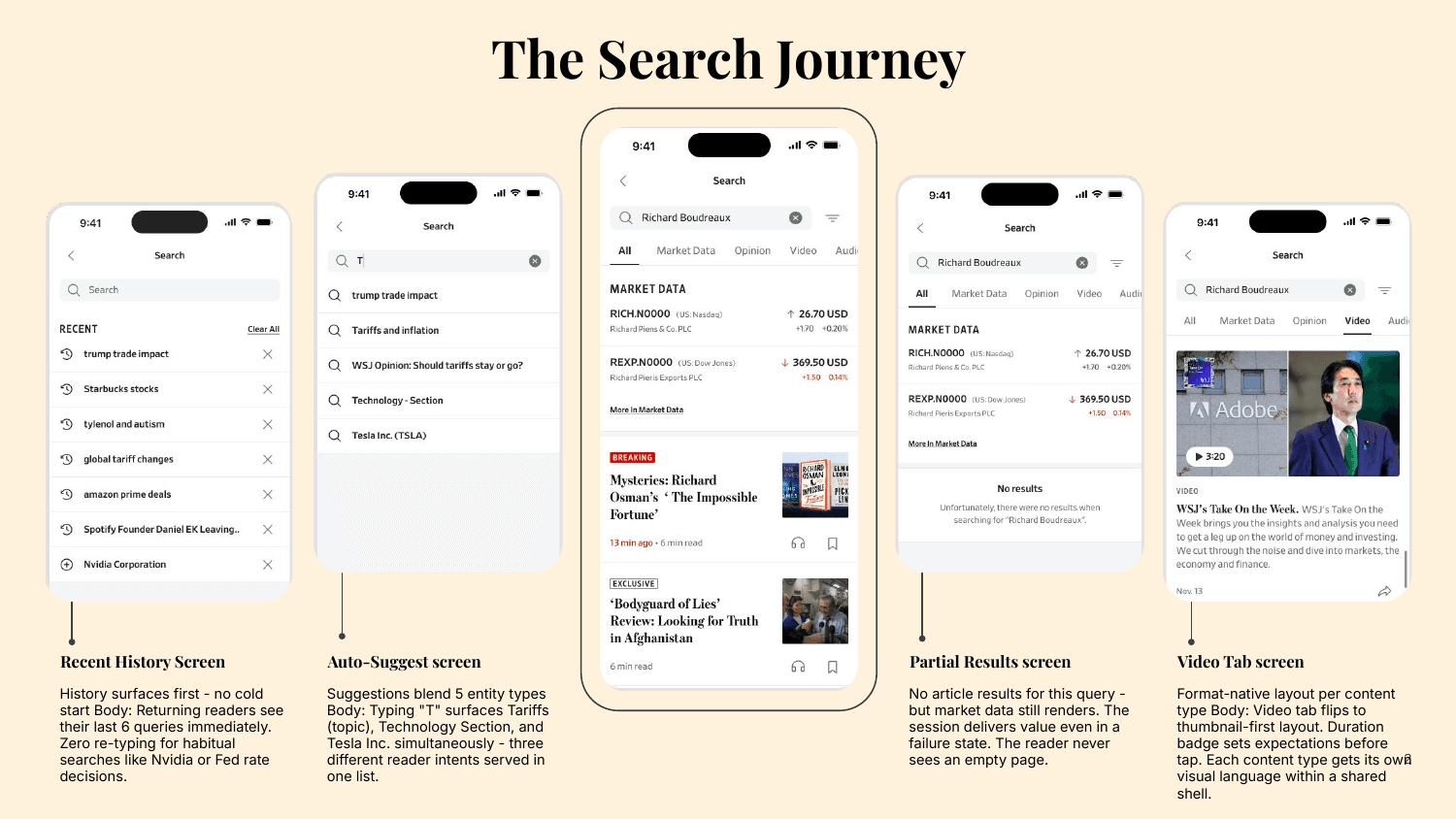
- A shared tabbed structure let subscribers switch among five content types without starting a new search.
- Outcome and scope
- Seven reusable components went back into the Index Design System. Filter and market-data patterns were reused beyond search.
The Wall Street Journal mobile app serves millions of subscribers across news, markets, opinion, video, and podcasts. Search worked for retrieval, but stopped there - no path forward, no related context, no way to follow a topic. I led the redesign that transformed search from a content-retrieval tool into a discovery and navigation platform, built as an extension of the WSJ Index Design System.
What I owned
- I owned: product direction, information architecture, the interaction model, and component design
- Partners: product, user research, editorial, and iOS and Android engineering
- Constraint: active product under NDA, so this study stays high-level
Overview
Search was reframed as a primary navigation and discovery surface rather than a single-purpose results page. The work spanned product strategy, information architecture, UI and UX, component creation, and close engineering collaboration across iOS and Android.
Business goals
- Increase content engagement per session
- Improve subscription value perception
- Reduce navigation friction and surface premium content faster
- Enable multi-format discovery across news, markets, opinion, video, and audio
User goals
- Find relevant content in fewer steps
- Discover topics beyond a single query
- Return to followed stories, authors, and companies easily
- Access live market data alongside the news
The challenge
Search was optimized for retrieval. WSJ needed it to become a discovery and navigation platform serving three different reader intents at once.
- Known-item search worked - 'Tesla earnings' or 'Fed rate' returned precise results - but it dead-ended with no path forward.
- Exploratory search had no mechanism: readers wanting to understand AI, inflation, or tariffs were returned articles only, with no way to explore across content types.
- Habitual tracking forced subscribers following Nvidia or a columnist to re-type the same query every session. No following, no continuity, no personalized return path.
Outcomes and impact
Impact landed across four dimensions: user experience, product and business, design system, and engineering delivery.
- Reduced navigation friction - search-as-navigation validated by an observable behavior shift.
- Discovery improved - three content types previously invisible to search-primary readers now surface.
- Tab architecture enabled exploration within a single search entry, and subscribers reach live market data without leaving editorial context.
- Seven reusable components contributed back to the WSJ Index Design System, with the filter and market-data patterns reused beyond search.
- Nineteen screen states fully specified with component, state, interaction, and accessibility documentation, and no hardcoded values in any component handoff.
I led the redesign of WSJ mobile search by extending the Index Design System, creating seven new reusable search patterns, and unifying discovery across editorial, market, video, and audio content at scale.
Continue reading
11 sections · 24 screens are protected. Enter the password, or request access.