[ Case study ]
Factiva Advanced Search & Search Builder
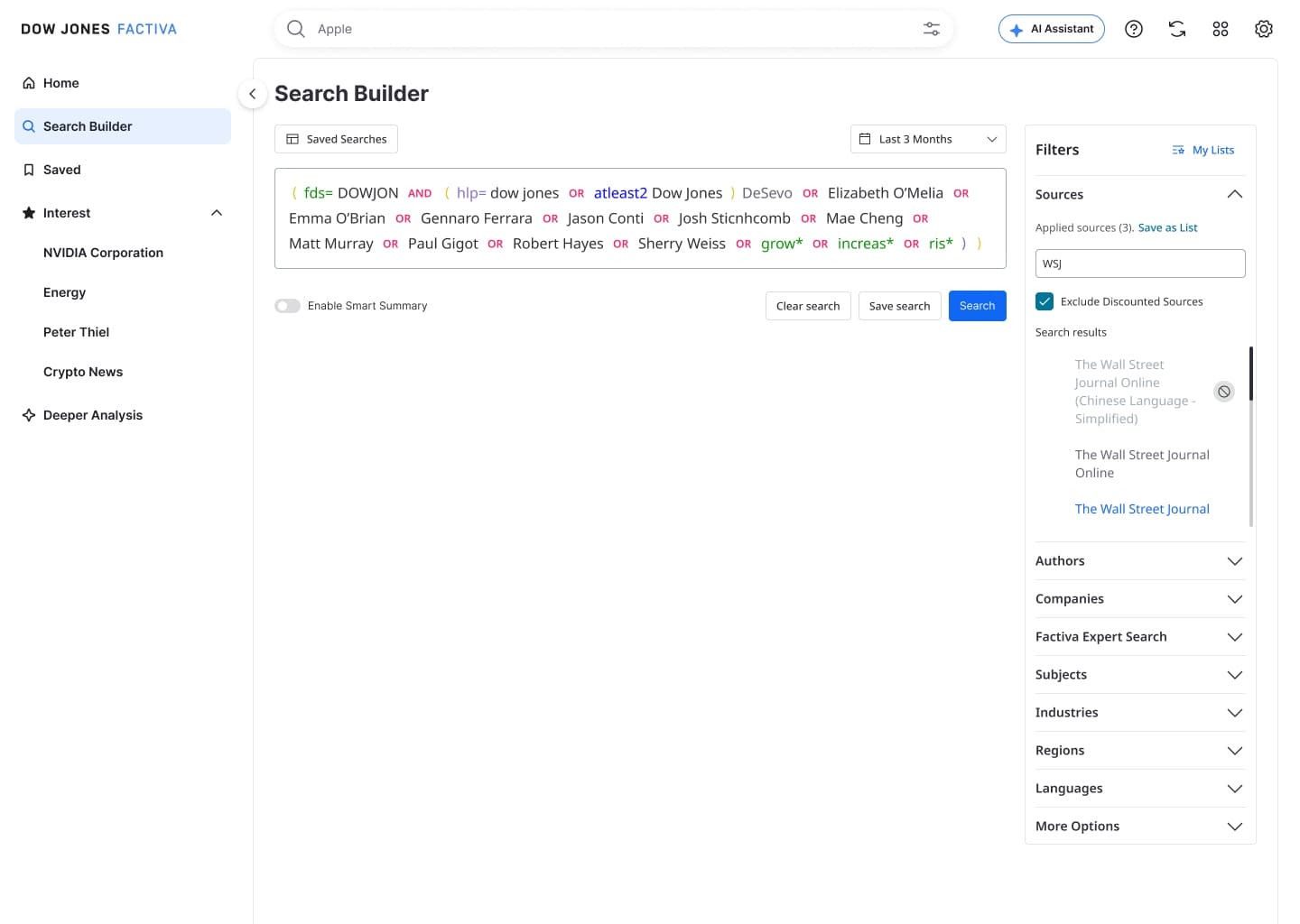
Search drives over 75 percent of Factiva's page views, and its most capable search lived in a decades-old Classic boolean interface that loyal power users refused to give up. I led UX architecture for the redesign across connected workstreams: a rebuilt Search Builder, unified filters, entity-aware results, and intent-aware entity links. Grounded in a Customer Insights concept evaluation, the work merged boolean precision with semantic ease around three principles, focused, in control, and flexible, to migrate the hardest users without taking away their control.
- Client
- Dow Jones - Factiva
- Role
- UX Architect
- Year
- 2024
- Disciplines
- UX Design, Search
[ Impact ]
2.0
Search Builder rebuilt for advanced queries
[ Information architecture ]
Query builder
- Terms
- Operators
- Fields
Filters
- Source
- Date
- Region
- Subject
Saved searches
- Saved queries
- Alerts
Results
- List
- Article view
Confidentiality notice
This work spans active platform strategy, shared AI capabilities, and multiple product surfaces. To respect that, this case study stays intentionally high-level, focusing on the cross-brand design problem, platform principles, and reusable outcomes rather than brand-specific implementation details.
Rebuilding the search experience that drives three-quarters of Factiva's usage, and migrating loyal power users off a twenty-year-old boolean tool without taking away their control.
Power users do not migrate for features. They migrate for control, focus, and transparency.
Overview
Search is the heart of Factiva: it drives over 75 percent of the platform's page views. But the most capable search lived in Classic Factiva, a powerful, decades-old boolean interface that loyal professional users refused to give up. Moving those users onto New Factiva (DJ+) without taking away their control was a make-or-break migration problem, and an FY25 company priority.
I led UX architecture for the search redesign across several connected workstreams: a rebuilt Search Builder, entity-aware results, unified filters, and navigational entity links. The throughline was to merge the precision of advanced boolean search with the ease of semantic search inside one modern, focused experience.
The project
Give New Factiva a search experience credible enough to migrate the most demanding classic users, by merging semantic and advanced search and making people feel more focused, more in control, and flexible enough to build any query they need.
I led design and research across the search workstreams, partnering with product and Customer Insights. I framed the migration problem, translated research findings into design principles, and designed Search Builder, unified filters, entities, and entity links through to engineering handoff.
A connected set of search experiences that bring boolean-level precision to a modern, guided interface, plus intent-aware entity links that turn search from a document finder into a navigational tool.
The migration problem
Customer Insights ran a Phase 1 concept evaluation to understand how Classic Factiva customers build and revise searches, and what it would take to move them. The core tension was loyalty to boolean: classic users had deep muscle memory and trusted the control that only the old interface gave them.
Designing the search experience
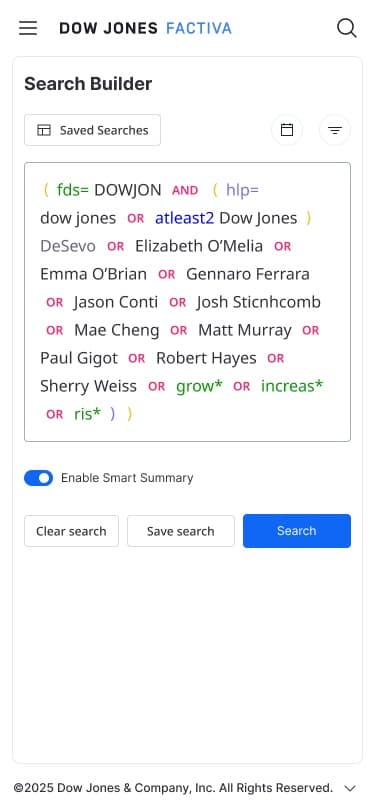
The concept evaluation clarified three levers that would motivate migration, and these became the design principles for the whole workstream: focused, a full-screen building experience that removes distraction; in control, key filters surfaced up front and the sources in scope made explicit; and flexible, enough expressiveness to match boolean without the raw syntax.
A full-screen, structured way to compose and revise a query that gives boolean-level precision through a guided interface. Key filters are promoted to the surface, the sources being searched are made explicit, and revising a search is a first-class, low-friction action rather than a restart.
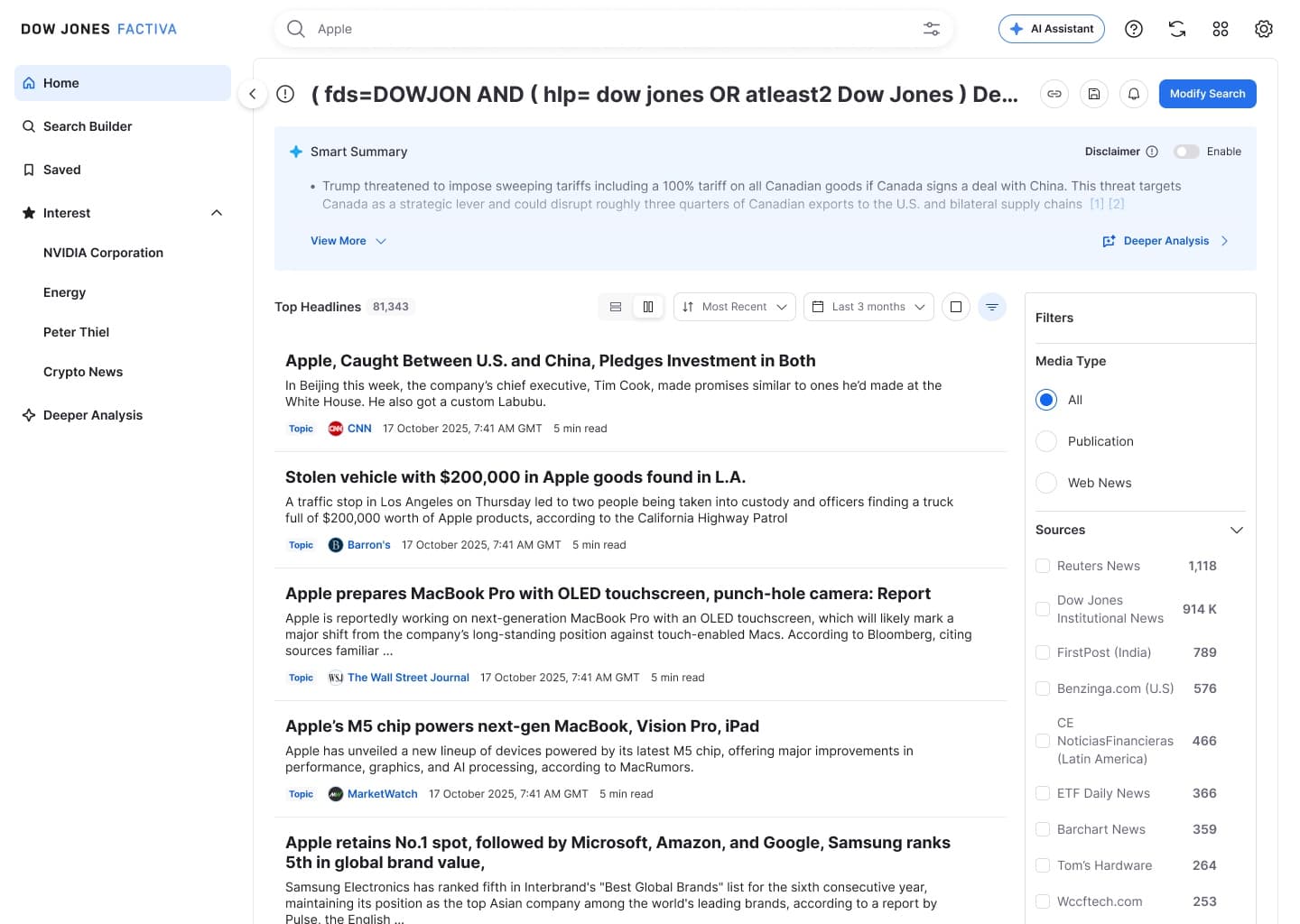
Fragmented, inconsistent filters were consolidated into a single coherent system with clear state and prioritised controls. Entity-aware results recognise when a query is really about a company, a source, or an industry.
Entity Links
When a user searches a known entity, Microsoft, Microsoft 10K, or a source like The Wall Street Journal, they usually want the entity itself, not a list of documents that mention it. Previously, results returned only matching content, forcing extra navigation to reach a company profile, a regulatory filing, or a source page.
When a query matches a known entity, or an entity plus a content type such as company plus report type, the system displays single-purpose buttons at the top of results.
Each button is a direct link to the relevant entity page in Factiva: a company profile, a 10-K filing, an industry page, or a source page. It reads the user's inferred intent and removes the extra navigation steps.
Delivery and measurement
The redesign shipped across multiple milestones in close partnership with product and engineering, each workstream specified for build and aligned to the Factiva and Index design systems.
Success was framed around migration and search efficiency: classic-to-new migration rate, adoption of Advanced and Search Builder among new-Factiva users, entity-link click-through, and how easily users revise a query.
Winning the hardest users
The lesson that stuck: you do not win power users with more power, they already had that in Classic Factiva. You win them with control, transparency, and focus. Designing the migration around how it felt to build a search, not just what features existed, is what made New Factiva a credible home for the people who were hardest to move.
[ Protected layer ]
The full case study is available on request.
High-fidelity screens, information architecture and the detailed process for this enterprise project are shared under NDA. Enter the access password, or request access and I will share the full walkthrough.