[ Case study ]
Factiva Search & Personalization Platform Library
The shared component library behind Factiva's AI search surfaces. Every AI component, Smart Summary, chat, feedback, and related search, was built into one library and shipped in two design systems at once, so a platform migration and the AI roadmap could run in parallel without blocking each other.
- Client
- Dow Jones - Factiva
- Role
- Senior UX Architect
- Year
- 2026
- Disciplines
- Design Systems, Design Tokens, Component Architecture, AI Product Design, Governance, Personalization
[ Impact ]
2 systems
Every AI component built against both UDS and Index from one library
8 states
On the chat selection control alone, including rename and multi-select
1 source
Smart Summary, chat, feedback, and related search from a single library
Confidentiality notice
This work spans active platform strategy, shared AI capabilities, and multiple product surfaces. To respect that, this case study stays intentionally high-level, focusing on the cross-brand design problem, platform principles, and reusable outcomes rather than brand-specific implementation details.
Behind Factiva's AI search experience sits a shared component library: the single source the Smart Summary, chat, and related-search surfaces are all built from. This is the systems layer under the product work, and it is where the decisions that keep an AI feature from fragmenting actually get made.
The problem a platform library solves
AI features tend to arrive as one-off screens. A summary is designed for search results, then designed again slightly differently for a company page, then again for chat, and within two quarters the product has four AI surfaces that behave like cousins rather than siblings. The visual drift is the visible symptom; the real cost is that every fix has to be made four times, and the trust patterns, citations, disclaimers, feedback, get quietly inconsistent.
Making the AI surfaces a library rather than a set of screens was the decision that prevented that. It also meant the trust model could be enforced structurally: if the summary component carries its sources control and its feedback controls, then every place a summary appears inherits them.
One library, two design systems
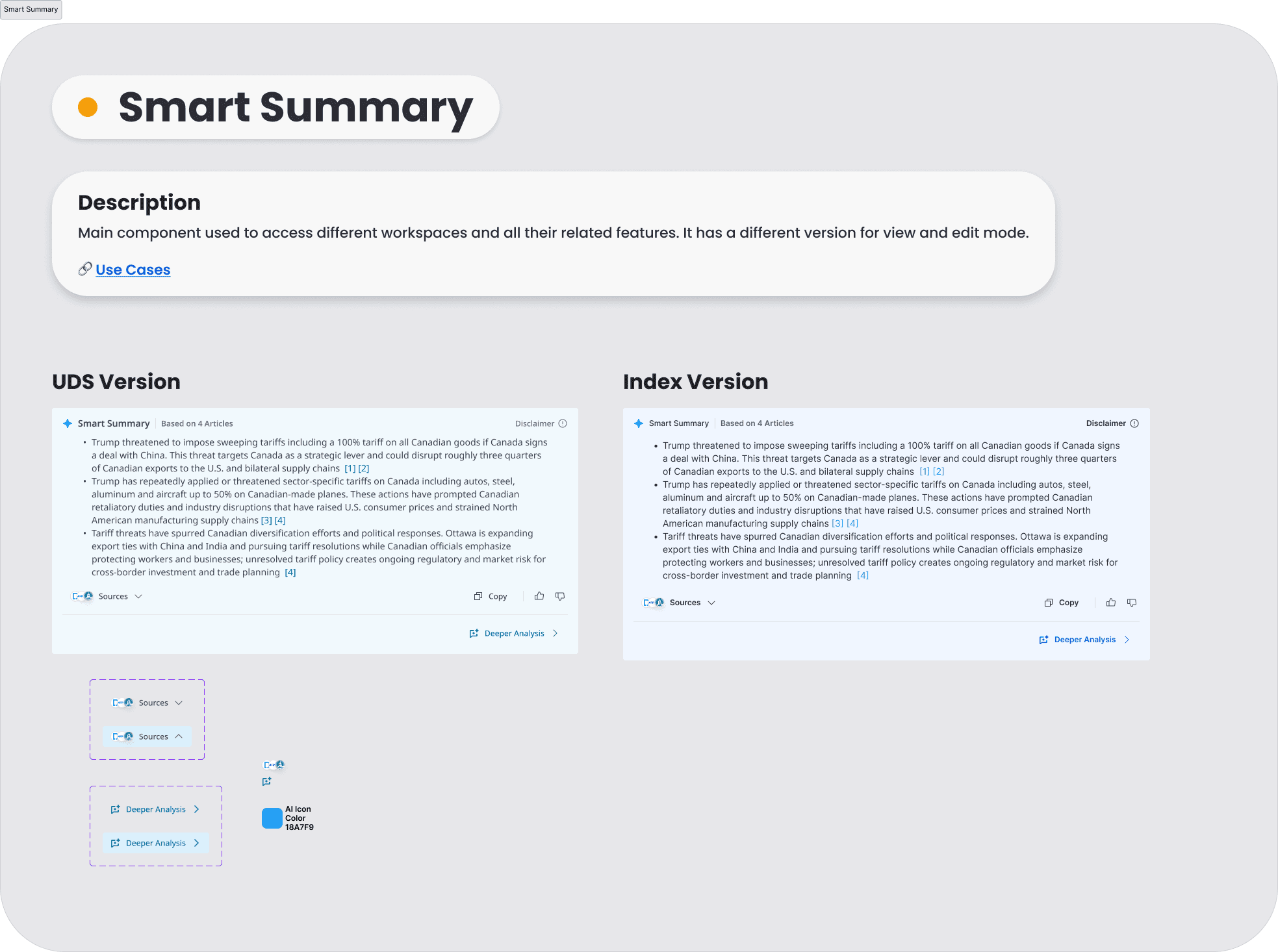
The hardest constraint was that these components had to exist in two design systems at once. Dow Jones was mid-transition, so every AI component was built twice: once against the Unified Design System and once against Index. The Smart Summary, the feedback controls, and the supporting buttons all ship as paired UDS and Index builds from the same library file.
That is not duplication for its own sake. It let product teams adopt the AI surfaces on whichever system they were already on, without waiting for a migration to finish, and it let the migration proceed without freezing the AI roadmap. The two builds stay behaviourally identical and diverge only where the underlying system demands it, so the interaction contract is the same whichever one a team consumes.
Shipping the same component into two design systems is not duplication. It is what lets a platform migration and a product roadmap run at the same time without either one blocking the other.
What the library holds
The library covers the full AI search surface rather than a token set of pieces:
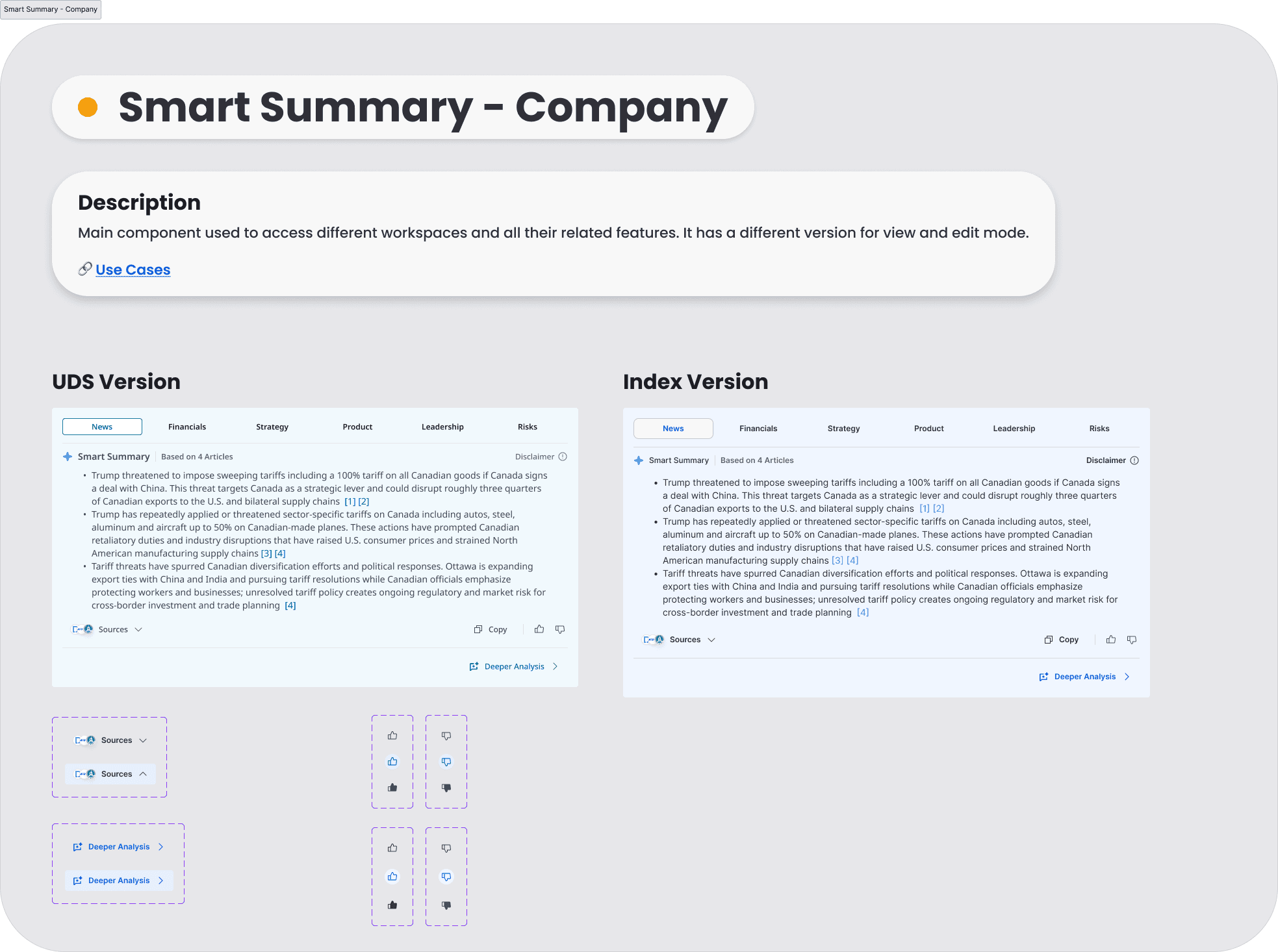
- Smart Summary, in both a search-results and a company-page composition, each with its sources control, dropdown, Deeper Analysis entry point, and feedback controls.
- Feedback controls, thumbs up and thumbs down, each with default, hover, and selected states, and built in both system flavours.
- Chat components: the conversation text field, the prompt button, chat selection, and the expand and collapse navigation icons.
- Related search and follow-up questions, with the paging arrows that move a reader through suggestions.
- A search-type banner that declares which mode the user is in.
[ Protected layer ]
The full case study is available on request.
High-fidelity screens, information architecture and the detailed process for this enterprise project are shared under NDA. Enter the access password, or request access and I will share the full walkthrough.