Case study
Factiva AI: Smart Content
Factiva's users are accountable for every claim they act on. As Senior UX Architect / Product Designer II, I led design and research for Smart Content, the generative AI layer built into search, reading and briefing: Smart Summary, the AI Assistant, Smart Reports and Smart Alerts, every claim cited and grounded in licensed content. It reframed Factiva search from finding documents to getting the answer, with the documents attached.
Shown in abstracted form. Some details are withheld under NDA.
Shipped
Generative AI live inside New Factiva for every accountCited
Every answer traceable to a licensed sourcePlatform
One AI layer shared across Dow Jones products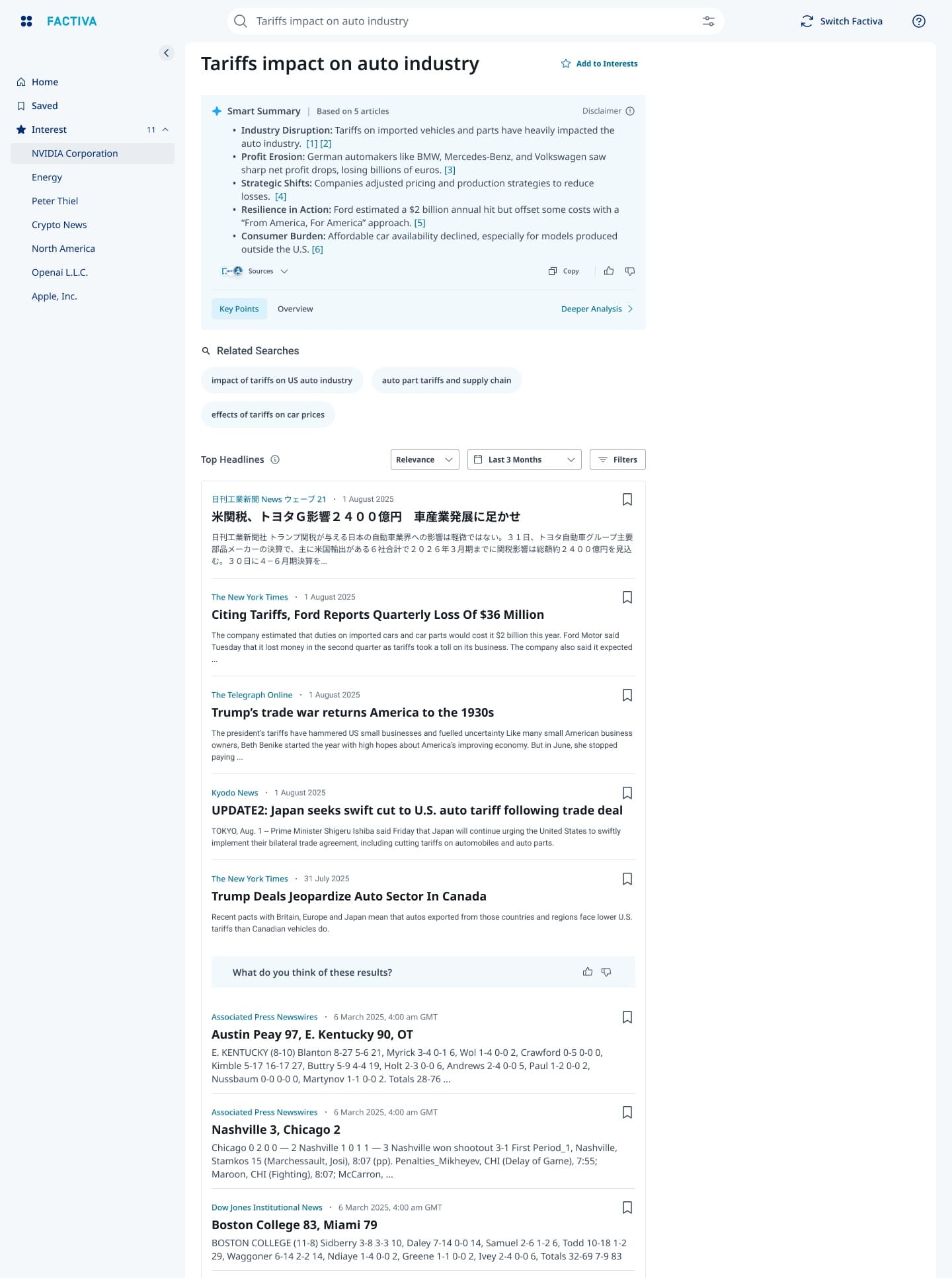
- AI Product Design
- Agentic UX
- Generative UI
- Multi-step Task Flows
- Design Systems
- Research
Project overview
- Problem
- Researchers needed to find answers across large sets of news and verify them against the original reporting.
- My contribution
- I led UX design and research for AI-assisted search, reading, and briefing in Factiva.
- Design decision
- I brought summaries into the existing research workflow and paired generated claims with inline citations.
- Outcome and scope
- The work covered Smart Summaries and Company Reports, with Research Copilot explored as a next step.
Factiva's users are accountable for every claim they act on. I led design and research for Smart Content, Factiva's generative AI layer, so professionals could get answers in seconds and still defend every one of them.
- 1AI. Scope disclosure: the summary says how many articles it was built from before giving the answer.
- 2Research. Every point carries inline citations that jump straight to the underlying article.
- 3Components. The disclaimer is a named, reusable component, so honesty about limits cannot be lost in a later revision.
- 4IA. Depth on demand: glance at Key Points or the Overview first.
- 5AI. Deeper Analysis opens a dedicated view with headline sources in a right rail.
- 6Prototype. Copy, thumbs up and thumbs down: a feedback loop on every generated output.
- 7Wireframe. The answer sits above the results, not instead of them: the documents stay attached.
The stakes
Factiva is Dow Jones's professional research platform: a vast licensed archive of news, company data and market intelligence, used by analysts, bankers, PR professionals, consultants and executives. Its depth is its value and also its cost: finding, reading and synthesizing the right material is slow, manual work. Dow Jones was the archive; the customer did all the analysis.
Generic AI does not solve that for these users. A fluent summary is no use to a banker or analyst who cannot show where each point came from, or defend it under legal and editorial scrutiny. The product had to be fast and checkable at the same time.
What I owned
- Role: Senior UX Architect / Product Designer II on Design and Research, owning design direction end to end across the milestone roadmap.
- I owned: framing the problems, mapping the research workflow from query to insight, defining the interaction model, and designing the summary, company report and chat experiences and their verification model through to build-ready specifications and handoff.
- I built the prototypes on live retrieval, so design decisions were made against real answers from the corpus rather than mock-ups.
Outcome and what I learned
- Launched inside New Factiva as a major AI release.
- The citation and trust patterns became the reference for AI experiences across Dow Jones.
- Smart Content grew from a hackathon idea into a milestone-driven, shipping initiative with sustained leadership backing.
- It reframed Factiva search from finding documents to getting the answer, with the documents attached.
- The citation and verification patterns became the trust model for AI work across Dow Jones, built as components of the Factiva, DJ+ and Index design systems rather than a separately styled AI zone.
- Engagement and trust signals were agreed with product and analytics up front, including citation clicks, which show whether people are actually checking the system.
Continue reading
15 sections · 7 screens are protected. Enter the password, or request access.