Case study
Factiva AI Assistant
A conversational research assistant embedded in New Factiva that answers only from Dow Jones licensed content, shows its sources before the answer, and flags when sources disagree. As Senior UX Architect / Product Designer II, I led its UX architecture and the citation pattern language that became the reference for AI across Dow Jones.
Shipped
Live inside New FactivaCited
Every significant claim links to a checkable sourceLicensed
Grounded in Dow Jones content, not the open web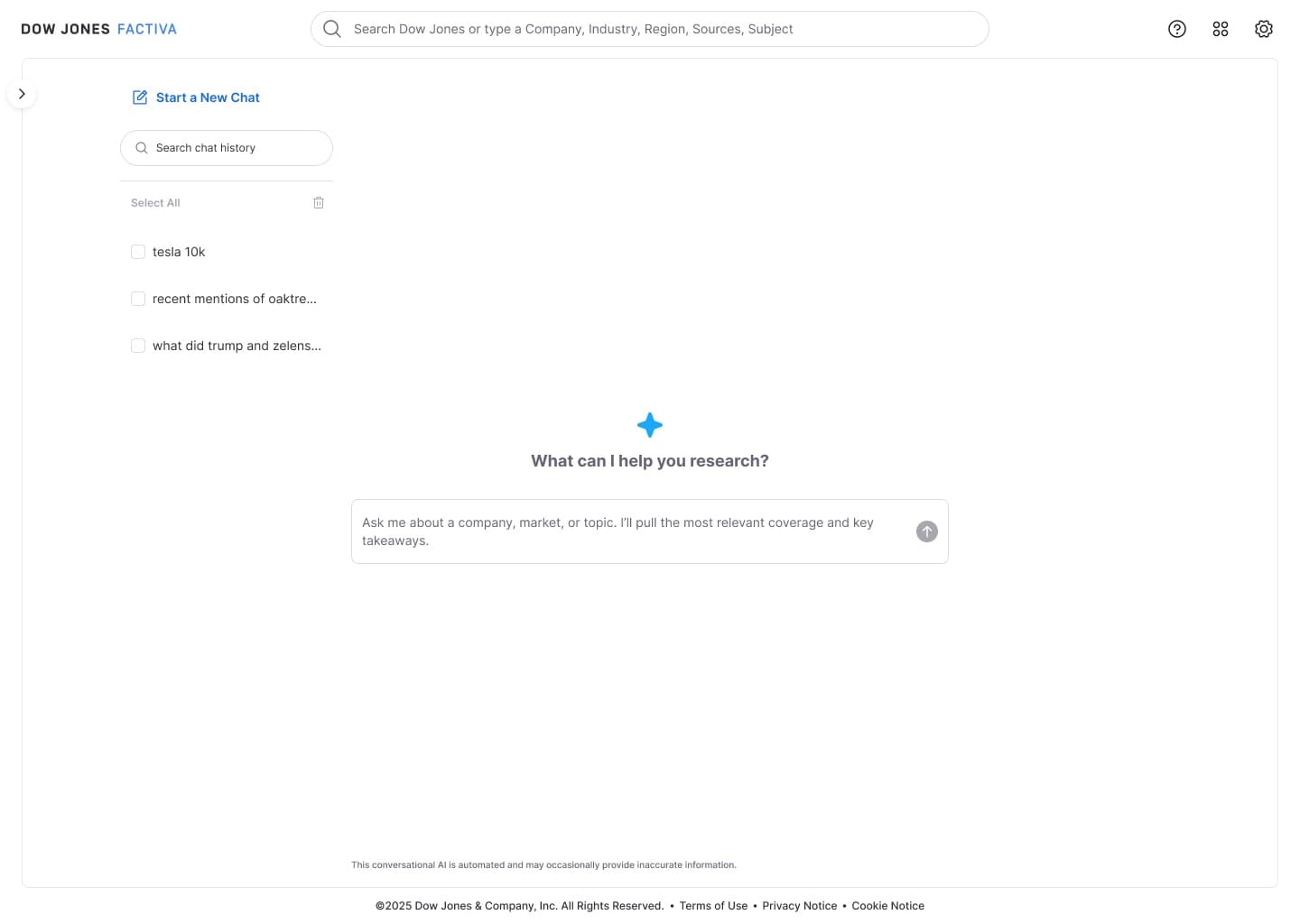
- AI / UX
- Design Systems
The Factiva AI Assistant is a conversational research assistant inside Factiva. I led its UX architecture: the conversation model and, at its core, the pattern language of citations, sources and uncertainty that lets a professional rely on its answers.
- 1Wireframe. It opens on a research question, not a chat greeting, so it reads as a research tool from the first screen.
- 2AI. The prompt sets the scope: a company, market or topic, answered from licensed coverage.
- 3IA. History sits beside the conversation from the start, because research is rarely one question.
- 4Components. Select and delete: history is managed, not just listed.
- 5A11y. A standing disclaimer, built as a reusable component, so honesty about limits is always on screen.
What I owned
- Role: Senior UX Architect / Product Designer II, leading UX architecture for the assistant.
- I owned: the conversational interaction model, the citation and source pattern language, the conversation lifecycle from prompt to answer, history management, and the mobile experience.
- I built the prototypes on live retrieval, testing the conversation against real answers from Dow Jones content before it was specified for engineering.
- Partners: product management and engineering, building on the Smart Content trust model.
The stakes
Factiva's researchers, analysts and journalists do not need answers faster as much as they need answers they can repeat to a client, an editor or a lawyer. An assistant that sounds confident but cannot show its working is a liability to them. So the assistant had to stand apart from general-purpose chatbots on one thing: every answer had to be checkable.
It also had to live where the work happens, inside the product rather than in a separate destination.
Outcome
- Shipped inside New Factiva.
- The citation, attribution and uncertainty patterns became the reference for AI across Dow Jones, so users meet the same honest behavior wherever AI appears.
Continue reading
6 sections · 8 screens are protected. Enter the password, or request access.