[ Case study ]
Factiva AI: Smart Content
As Senior UX Architect, I led design and research on Factiva AI, internally Smart Content, a generative-AI layer woven into search, reading, and briefing rather than bolted on as a chatbot. The work turns slow manual research into instant Smart Summaries, Company Reports, and a forward-looking Research Copilot, with every claim tethered to inline citations so verifiability is a first-class feature. It reframed Factiva search from finding the documents to getting the answer, with the documents attached.
- Client
- Dow Jones - Factiva
- Role
- UX Architect
- Year
- 2025
- Disciplines
- AI Product Design, Agentic UX, Generative UI, Multi-step Task Flows, Design Systems, Research
[ Impact ]
Shipped
Milestone builds shipped into Factiva
M1 to M4
An agency ladder from single-shot synthesis to multi-step research with memory
Cited
Every significant claim carries a path back to its source
[ Information architecture ]
Smart Summary
- Key points
- At a glance
Smart Content
- Generated brief
- Highlights
Sources
- Citations
- Source documents
Confidentiality notice
This work spans active platform strategy, shared AI capabilities, and multiple product surfaces. To respect that, this case study stays intentionally high-level, focusing on the cross-brand design problem, platform principles, and reusable outcomes rather than brand-specific implementation details.
Designing a trusted, generative-AI research layer for Factiva that turns manual, time-consuming research into instant, verifiable summaries, company briefings, and a research copilot.
For high-stakes professional decisions, generic AI is not enough. Win on trust, verifiability, and editorial authority.
Overview
Factiva is Dow Jones's professional research platform: a vast licensed archive of news, company data, and market intelligence relied on by analysts, bankers, PR professionals, consultants, and C-suite executives. Its depth is its value, and also its tax. Finding, reading, and synthesising the right material across thousands of sources is slow, manual work.
Factiva AI, internally Smart Content, put generative AI to work on that problem. Not as a chatbot bolted onto the side, but woven into search, reading, and briefing so the value shows up exactly where the work happens. I led design and research across the milestone roadmap, from the hackathon that started it to the shipped milestone builds and the forward-looking Research Copilot.
The project
Transform how Factiva's professional users research by replacing manual reading and synthesis with instant, trustworthy AI. The vision: every answer is one tap from its evidence, AI lives inside the existing workflow, and the experience earns the trust that high-stakes decisions demand.
As Senior UX Architect on Design & Research, I owned the design direction end to end across milestones. I framed the problems, mapped the research workflow from query to insight, designed the summary, briefing, report, and chat experiences and their verification model, kept the work aligned to the Factiva, DJ+, and Index design systems, and produced build-ready specifications and handoff.
Smart Content moved from a hackathon idea into a milestone-driven, shipping initiative with sustained leadership backing. The work reframed Factiva search from find the documents to get the answer, with the documents attached, and established the citation and verification patterns now used across the AI roadmap.
The challenge of professional research
Discovery, grounded in customer interviews and persona analysis, surfaced six recurring problems. The early milestones tackle the blank-slate problem of summarisation; the later ones address how research actually unfolds over time. Five professional personas shaped every decision: analysts and consultants who live in the detail, PR professionals who monitor narrative and risk, bankers and C-suite executives who depend on teams for synthesis, and professional researchers who translate vague requests into search strategies.
Smart Summaries: the anatomy of trust
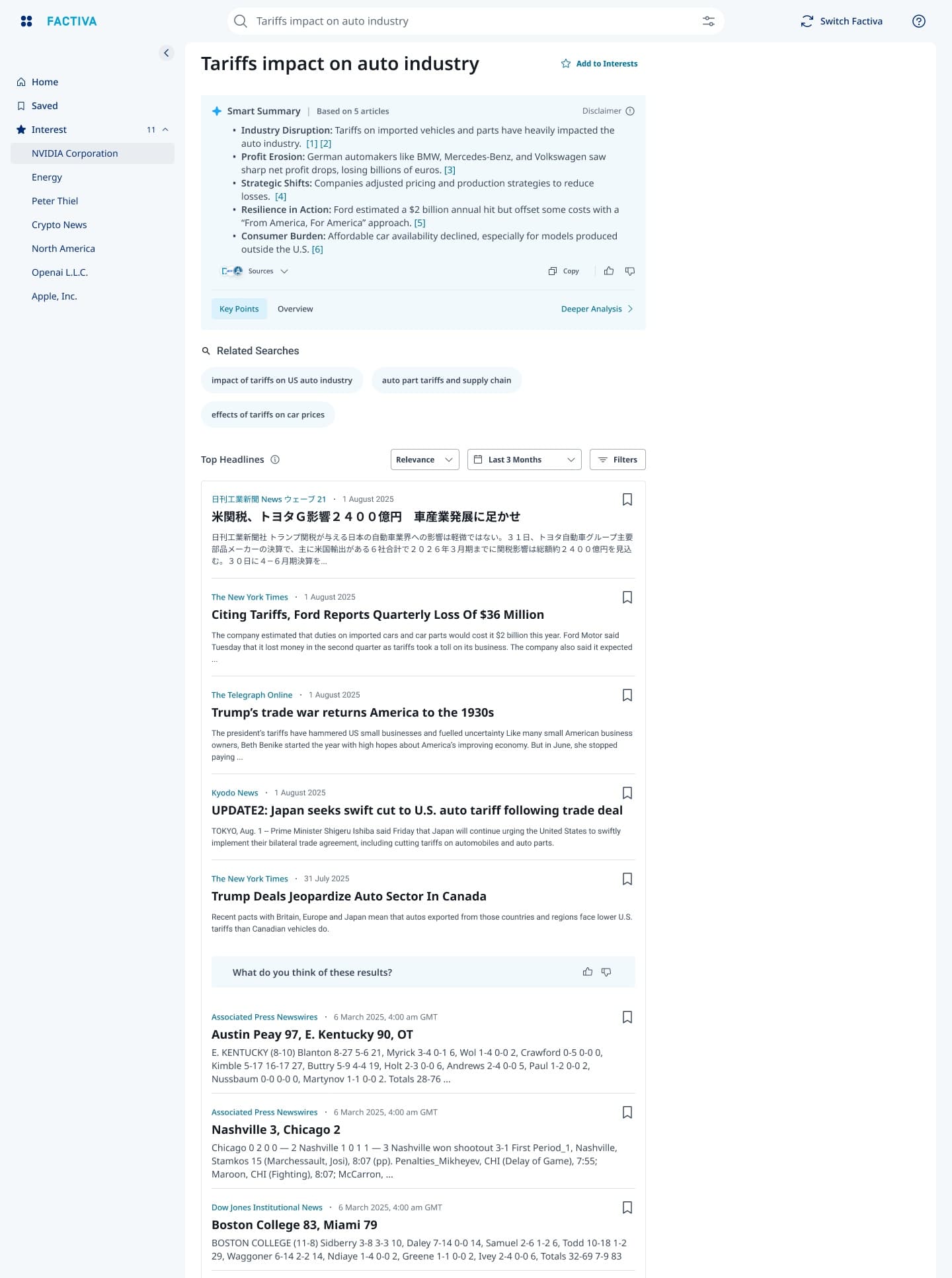
A Smart Summary offers depth on demand: a Summary view, a Bullets view, and a Go deeper with analysis path into a dedicated Deep Analysis view. Glance first, drill down only when needed, so speed never costs the user thoroughness.
Every claim is backed by inline citations and sources. From any citation a user jumps straight to the underlying article, and the Deep Analysis view keeps headline sources in a right rail. Verifiability was treated as a first-class feature, not a disclaimer.
Users can copy a summary, give thumbs up or thumbs down, and control where summaries appear. Summaries also surface inside Search Builder, where users can enable or disable the display, keeping people in control of the AI.
Company Summaries and Reports
Company Summaries introduced lenses: tabbed perspectives such as news, financials, and strategy. A user pivots the same entity through different analytical frames, each summarised and cited. M2 was where Smart Content stopped being a feature and became a re-think of search itself.
M2.3 Company Reports auto-generate a long-form briefing that combines fixed sections, such as Financial Performance, with dynamic sections, such as an AI Strategy section that adapts to the entity. A sticky table of contents makes a long document navigable, and inline bracketed citations plus a full references section keep it verifiable at scale.
Reports load from cache when fresh, under 24 hours, show a historic view when older, or trigger a new generation. A non-blocking stale-warning banner offers a Generate New Report action, so users always know how current the AI content is without being blocked.
Research Copilot
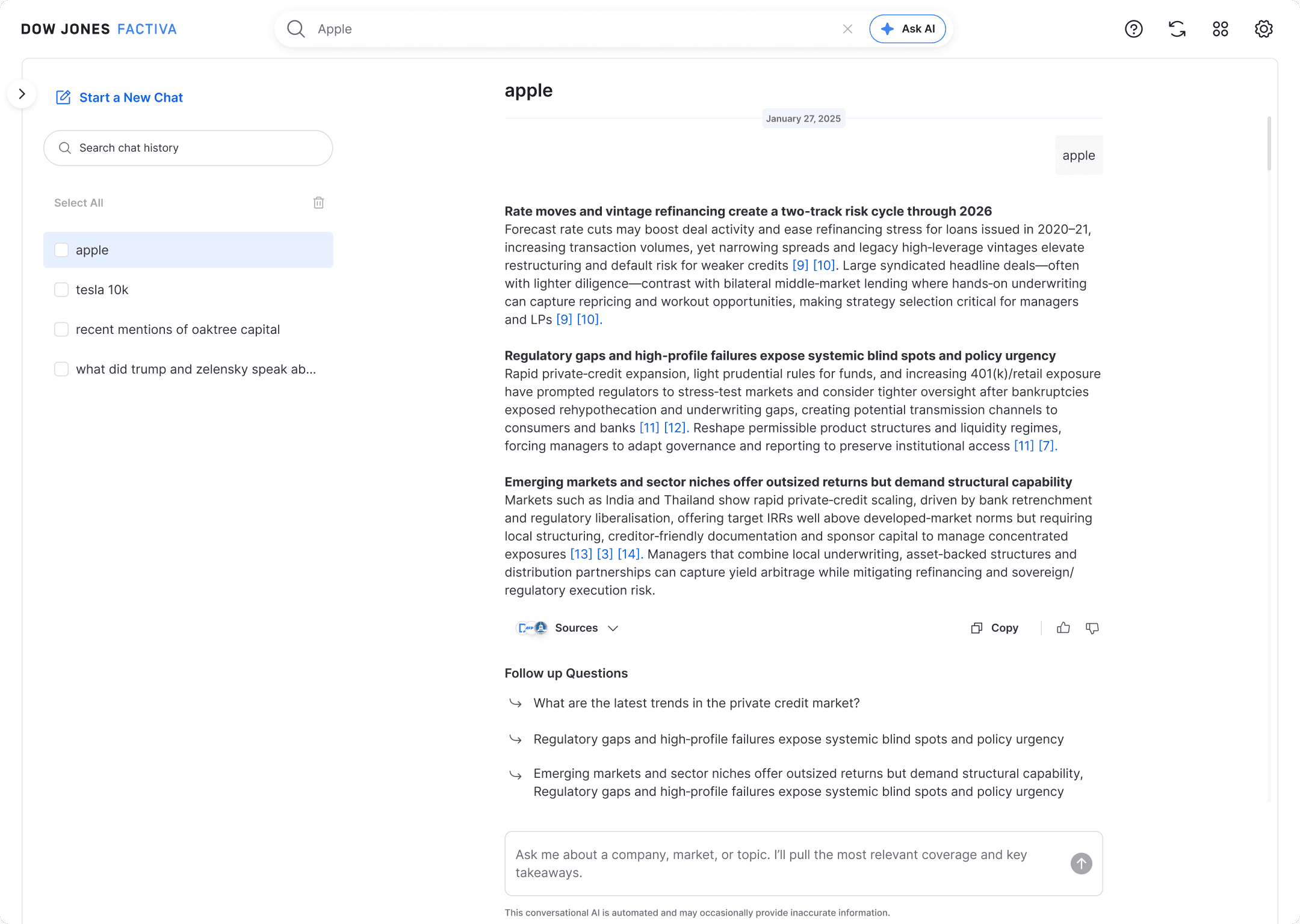
M1 and M2 solved the blank-slate problem; M3 addresses what happens next, the messy, ongoing research process. Branded internally as Research Copilot, it ladders conversational capability up in stages while keeping the same trust model.
M3.0 bounded chat lets users ask questions against a defined, scoped set of content; M3.1 opens this to unbounded questions across the corpus. Parallel explorations, a Chat Bot concept and FactivaGPT, pressure-tested conversational retrieval and a more open assistant direction.
M3.2 deep research runs multi-step research that extracts the specific answer, not just a list of documents, directly attacking the signal-from-the-noise problem.
M3.11 chat history makes AI output durable rather than disappearing after a session, attacking the stateless problem. M4 adds personalization, memory of a user's and team's interests and portfolios, cross-entity analysis, and shared, saveable research, answering the one-at-a-time and siloed-workflow problems.
From concept to production
I worked in a tight cross-functional team with the Director of Product Design, the VP of Product Platforms, the product lead, and engineering. The initiative began as a hackathon with broad leadership sponsorship, including the SVP of Design and a Senior Principal PM, then narrowed to a focused core team for milestone delivery.
Working with product and analytics, we defined explicit engagement and trust signals up front: clicks on Overview, Bullets, and Go deeper, which view users land on, citation and source clicks, thumbs up and down, which lenses users engage, report freshness states and table-of-contents navigation, and Search Builder adoption.
Each pattern was specified for engineering and aligned to the Factiva, DJ+, and Index systems, so the AI experience shipped as part of the product rather than a bolt-on.
Shaping trustworthy AI for professionals
The defining challenge was not making AI summarise, models do that. It was making professionals trust the output enough to build decisions on it. Designing for verifiability, tethering every claim to its evidence and every report to its freshness, is what separated a credible research tool from a plausible-sounding one, and it is the part of the work I am most proud of.
The other lesson was sequencing: solving the blank-slate problem earned the right to solve the harder, longitudinal problems of memory, multi-entity analysis, and collaboration. If I were starting again, I would push verification and currency patterns even earlier in exploration, because they ended up shaping nearly every downstream decision, and the trust model built here now informs AI work across Dow Jones.

Designing the ladder of agency
The roadmap was deliberately sequenced as increasing autonomy. Each milestone hands the system more of the research task, and each one had to earn that authority by proving the previous rung trustworthy. Designing the ladder, rather than jumping to a chatbot, is what kept the work credible with professionals whose decisions carry real consequences.
M1, single-shot synthesis. The system summarises what a search already returned. No autonomy over scope, and the rung where the citation and verification model had to be earned first.
M2, entity reasoning. The system pivots one entity through analytical lenses and assembles a long-form report on its own, choosing some of its own structure for the first time.
M3.0, bounded conversation. The system answers questions against a defined, scoped set of content. Autonomy in reasoning, inside a known boundary.
M3.1, unbounded conversation. The boundary is lifted to the full corpus, so retrieval scope becomes the system's decision rather than the user's.
M3.2, multi-step deep research. The system plans and executes a sequence of retrieval and reasoning steps to extract a specific answer, rather than returning a list of documents for the user to work through. This is the point where the product stops being a summariser and starts doing the research.
M3.11 and M4, memory and continuity. Chat history makes output durable instead of evaporating with the session, and personalization carries a user's and a team's interests and portfolios, enabling cross-entity analysis and shared, saveable research.
Read end to end, that ladder is the design argument: autonomy is not a switch, it is a sequence of permissions the system earns.
Delegation, orchestration, and scope
The central design decision in an agentic research tool is not what the model can do, it is how much the user lets it do and how legible that boundary is. Three mechanisms carried that.
Scope as a delegation contract. Bounded chat runs against a defined, scoped set of content, so the system reasons within a known boundary. Unbounded chat releases that constraint across the corpus. Making the two distinct modes, rather than silently widening retrieval, means the user always knows the territory the answer came from, which matters when an analyst or banker has to defend where a conclusion came from.
Lenses as routing. Company Summaries pivot a single entity through tabbed analytical frames such as news, financials, and strategy. Each lens routes the same entity down a different reasoning path and returns its own cited synthesis, so the user directs the analysis instead of relying on one undifferentiated answer.
Freshness as orchestration state. A report loads from cache when it is under twenty-four hours old, presents a historic view when it is older, or triggers a new generation. Because generated content silently ages, currency had to be a visible state in the interface rather than an implementation detail, so a user never mistakes a cached briefing for a live one.
Generative UI: when the model composes the interface
Company Reports were the point where the interface stopped being fully authored and started being partly generated. A report combines fixed sections, such as Financial Performance, with dynamic sections that adapt to the entity, so a company with a meaningful AI strategy gets an AI Strategy section that another company would not.
That breaks the assumption a designer normally relies on, that the layout is known in advance. The design problem becomes governing a space of possible outputs rather than drawing one, and the questions change with it: which sections are guaranteed and which are conditional, how a section should behave when the evidence behind it is thin, and how a document that varies in length and structure stays navigable. A sticky table of contents was the answer to that last one, giving a generated document of unpredictable shape a stable spine.
Progressive disclosure did the same work at the smaller scale. A Smart Summary resolves as an overview, a bullets view, or a deep analysis view, so the same generated content serves a glance and a considered read without producing two separate features.
Control, override, and the handoff back to the human
In professional research the human is never downstream of the system, they are accountable for it. Every generated surface therefore needed a way out, back to the evidence and back to user control.
Citations as the override path. Every significant claim carries an inline citation that jumps to the underlying article, and Deep Analysis keeps headline sources in a right rail. This is the handoff that matters: at any moment the user can leave the generated answer and stand on the primary source instead. Verifiability was treated as a feature, not a disclaimer.
Presence as a user setting. Users can enable or disable summaries and control where they appear, including inside Search Builder. A professional who does not want AI in a given workflow can turn it off without leaving the product, which is a meaningful trust concession in a product whose users are accountable for what they publish.
Non-blocking correction. A stale report surfaces a warning banner with a Generate New Report action, informing without interrupting. The user decides whether currency is worth a regeneration, rather than the system forcing the choice.
Feedback as a control loop. Copy, thumbs up, and thumbs down give the user a response to bad output and give the team a signal to act on, closing the loop between what shipped and what the model actually did in the field.
The unbounded chat, in detail
M3.1 is where the trust model was tested hardest, because once the system can answer across the whole corpus, the user loses the ability to see what it drew from. Three patterns carry that weight.
Scope disclosure. Every AI briefing states the evidence base it was built from, the number of articles and the date range they span, before the reader gets to the answer. It is a small line of text doing a large job: it converts an authoritative-sounding paragraph into a claim with a known basis, and it lets a professional judge whether that basis is adequate for the decision they are about to make. Summaries carry the same disclosure at their own scale.
The refusal state. The hardest screen in the set is the one where the system says it could not find what was asked, and offers a new search instead of an answer. A model will always produce something; designing the case where it should produce nothing is a deliberate act. Getting a not-found response treated as a first-class state, rather than an error or an empty container, is what stops a research tool from filling silence with plausible text.
Attribution with time. Citations name the publisher and carry a timestamp, not just a link. In financial research the age of a source is part of its meaning, so a citation that cannot tell you when it was published is only half a citation.
The standing disclaimer that the assistant is automated and may occasionally be inaccurate was built as a named, reusable component rather than copy dropped onto a screen, so honesty about the system's limits could not be quietly lost in a later revision. The same patterns were specified for mobile, because a briefing read on a phone carries exactly the same consequences as one read at a desk.
Designing around model behavior
Much of this work was designing for the ways a language model actually fails, rather than for the demo where it succeeds.
Grounding over generation. The system answers from Dow Jones licensed content, which constrains the model to a corpus the company can stand behind. That is a retrieval decision with a direct design consequence: the interface has to make the provenance of an answer as prominent as the answer itself.
Time is not something a model knows. Freshness states, historic views, and regeneration exist because generated content carries no inherent sense of its own currency, and a briefing that reads as current when it is not is worse than no briefing.
Non-determinism as a layout constraint. When part of the structure is generated, the representative case is not a safe thing to design against, so the question becomes how a layout holds at the sparse and the verbose end of what the system might return.
Instrumenting trust, not just usage. With product and analytics we defined the signals up front: which view users land on, citation and source clicks, thumbs up and down, which lenses get engaged, report freshness states, and table-of-contents navigation. Citation clicks are the interesting one, because they measure whether people are checking the system, which is the behavior a trustworthy research tool should produce.
Tokenization and shipping AI inside a design system
Generated surfaces are where design systems usually break, because the content will not hold still. Every AI pattern here was specified against the Factiva, DJ Plus, and Index design systems, so summaries, lenses, reports, and chat resolved as system components governed by the same type, spacing, and color decisions as the rest of the product, rather than a separately styled AI zone bolted onto it.
That mattered for more than consistency. Smart Content was specified responsively across desktop, tablet, and phone, so the AI surfaces hold their structure as the content behind them varies. And because the citation and verification patterns were built as part of the system rather than as one feature, the trust model established here now informs AI work across Dow Jones.
[ Protected layer ]
The full case study is available on request.
High-fidelity screens, information architecture and the detailed process for this enterprise project are shared under NDA. Enter the access password, or request access and I will share the full walkthrough.